
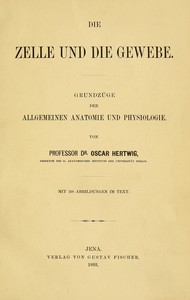
Die Zelle und die Gewebe (Vol. 1/2) : Grundzüge der allgemeinen Anatomie und…
Let's be clear from the start: this is not a novel. Die Zelle und die Gewebe (The Cell and the Tissues) is Volume 1 of Oscar Hertwig's two-part masterwork on general anatomy, published in the 1890s. Think of it as a guided tour of the cutting-edge biological understanding of its era. Hertwig was a leading embryologist, and this book is his attempt to synthesize everything known at the time about the fundamental unit of life.
The Story
There's no plot in the traditional sense. The 'story' is the unfolding discovery of cellular life. Hertwig starts by defining the cell—its membrane, nucleus, and the mysterious substance within (protoplasm). He walks you through how cells divide, how they specialize to form different tissues like muscle and nerve, and how these tissues come together to build organs. The narrative is the logic of science itself: observation, hypothesis, and evidence. You follow along as he explains the debates of the day, like how inheritance might work, using the very experiments that were shaping modern biology.
Why You Should Read It
Reading this today is a unique experience. It's not about learning current facts (much has changed!). It's about feeling the excitement of a field being born. You get inside the head of a brilliant scientist at a time when so much was unknown. His careful descriptions and reasoned arguments make you appreciate how hard-won our basic knowledge really was. There's a humble, questioning tone here that's different from a modern textbook. He often points out where knowledge ends and speculation begins, which is incredibly refreshing. It makes you a participant in the old quest for understanding, not just a recipient of answers.
Final Verdict
This book is a niche treasure. It's perfect for history of science enthusiasts, biology students curious about the roots of their field, or any curious reader who loves primary sources. You need some patience for the older style and terminology, but the payoff is a direct connection to a pivotal moment in human thought. If you enjoy seeing how ideas evolve, and you can get past the fact that it's in German (or find a translation), this is a profoundly rewarding look back at the foundations of life science.
Nancy White
1 year agoLoved it.
Dorothy Lopez
3 months agoA bit long but worth it.



Ava Hernandez
1 year agoVery helpful, thanks.