
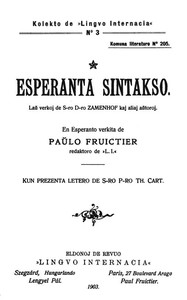
Esperanta sintakso by Paul Fruictier
Let's be clear: Esperanta Sintakso is a grammar book. But it's a grammar book with a soul and a mission. Published in 1912, it was written by Paul Fruictier, a dedicated early speaker of Esperanto, at a time when the language was a vibrant, growing movement. This isn't a textbook for modern learners; it's a foundational document, a guide written by someone building the road as he walked on it.
The Story
There isn't a plot with heroes and villains. Instead, the 'story' is the logical construction of Esperanto itself. Fruictier systematically walks through how sentences are built in this constructed language. He explains the role of its famous word endings (-o for nouns, -a for adjectives, etc.), how to connect ideas, and the rules for word order. He argues for the language's internal consistency and simplicity, often contrasting it with the irregularities of natural languages like French or English. The narrative is the unfolding of a system designed to be fair, clear, and accessible to all.
Why You Should Read It
You should read it for the historical vibe and the pure idealism. Holding this book (or its digital version) is like touching a piece of early 20th-century optimism. Fruictier's writing, while technical, is filled with a belief that this tool could foster international understanding. It's fascinating to see the language's logic laid out with such conviction. You get a real sense of the community that was forming around Esperanto—people who weren't just learning phrases, but deeply studying its architecture. It turns abstract grammar into the key for a proposed world peace.
Final Verdict
This book is absolutely not for everyone. It's a niche read. But it's perfect for language lovers, history enthusiasts, and anyone interested in constructed worlds or utopian ideas. If you've ever dabbled in Esperanto, it's an essential piece of your library's history. If you're a writer or thinker fascinated by how language shapes thought, this is a brilliant case study. Think of it less as a manual and more as an historical artifact—a snapshot of a time when people truly believed a better, simpler language could build a better world.
Jessica Gonzalez
1 year agoBased on the summary, I decided to read it and the emotional weight of the story is balanced perfectly. Definitely a 5-star read.
Lucas Lopez
1 year agoNot bad at all.
Amanda Wright
5 months agoFast paced, good book.
Joseph Hernandez
5 months agoIf you enjoy this genre, the flow of the text seems very fluid. I couldn't put it down.



Joshua Flores
1 year agoNot bad at all.