
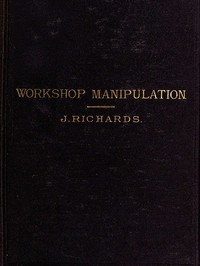
The Economy of Workshop Manipulation by John Richards
Okay, let's be clear from the start: you won't find a sweeping plot or a cast of characters here. The 'story' in The Economy of Workshop Manipulation is the story of process itself. Published in the 1870s, this book is a master craftsman's guide to the most efficient ways to work with metal and wood. Author John Richards was an engineer writing at the dawn of the modern factory age. His book systematically walks through the core skills of the workshop: filing, turning, planing, and fitting.
The Story
Think of it less as a narrative and more as a blueprint for thought. Richards lays out problems—like how to accurately bore a hole, shape a curved surface, or fit two parts together without expensive machines—and then presents the cleverest, most economical solutions. He explains the 'why' behind every cut and measurement. The drama is in the pursuit of perfection with limited tools. It's the quiet, intense story of how things were made before computers, when the gap between an idea and a physical object was bridged by supreme skill and deep understanding of materials.
Why You Should Read It
This book is a window into a mindset that's almost lost. Richards’s writing is direct and practical, but there's a profound philosophy underneath. It’s about respect for material, elegance in method, and the sheer intelligence of good craft. Reading it, I was constantly struck by how clever the old techniques are. It made me look at every ordinary metal object around me with new wonder. You get a real sense of the author's voice—a no-nonsense expert who wants to pass on real knowledge, not just show off. It’s surprisingly meditative.
Final Verdict
This isn't for everyone. If you need a fast-paced novel, look elsewhere. But if you're a maker, a history enthusiast, an engineer, or just someone curious about how our industrial world was built from the ground up, this book is a treasure. It’s perfect for tinkerers, model builders, or anyone who appreciates the beauty of a problem well-solved. It’s less a book you read cover-to-cover and more one you dip into, each section offering a little spark of inspiration from the past. A fascinating, foundational text for the hands-on mind.
Kevin Hernandez
6 months agoI stumbled upon this title and the depth of research presented here is truly commendable. Exactly what I needed.
Paul Jones
5 months agoAs someone who reads a lot, the content flows smoothly from one chapter to the next. A valuable addition to my collection.
Christopher Moore
1 year agoVery helpful, thanks.